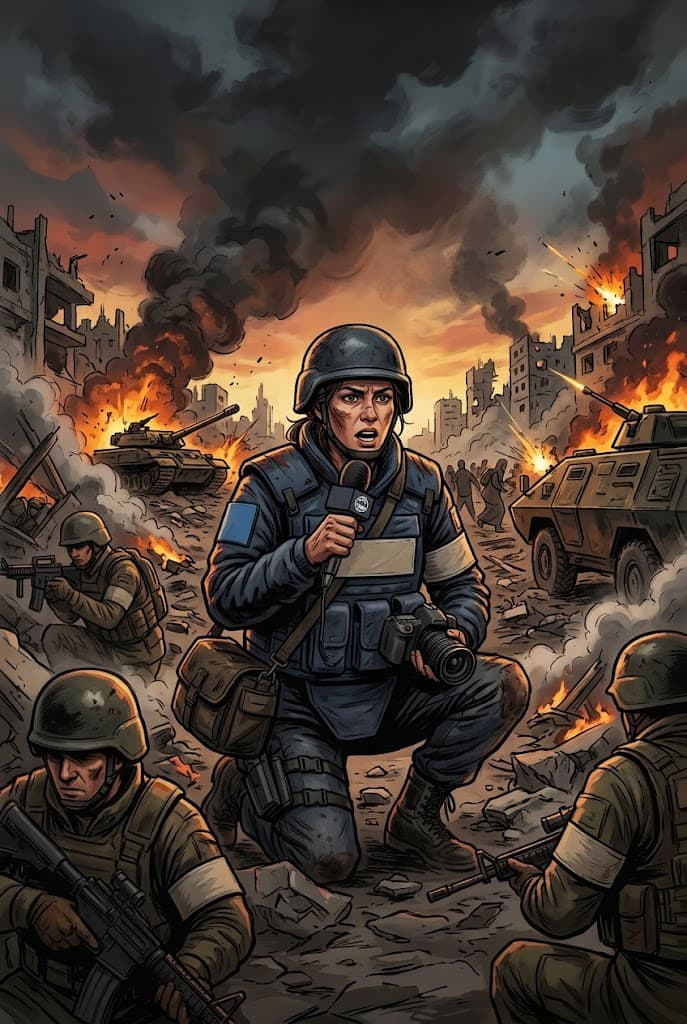
Leading a news operation in a war zone is not like managing a corporate office. The stakes are literal life and death. In Afghanistan, Iraq, South Sudan, and Syria, I learned that executive resilience is not just about making tough decisions under pressure — it's about protecting your people while ensuring the world still sees the truth.
The Weight of Responsibility
In a conflict zone, the first responsibility of a bureau leader is not breaking the news; it is ensuring that every member of the team returns safely. In Baghdad, the days began with a security briefing before the editorial meeting. The staff reviewed overnight incidents, road conditions and threat levels before reporters were assigned to the field. Every journalist heading out was equipped with a bulletproof vest, helmet and a clear emergency plan.
The bureau itself operated more like a fortress than a conventional office. Three layers of security protected the building: armed guards at the entrance, reinforced doors and a basement refuge stocked with essential supplies. The three-layer approach was critical because it reduced the risk of bribery, complicity or a single compromised security point.
Security, however, was not always about being more visible. At our Doha head office, we had several armoured vehicles available for personnel working in conflict zones. Most declined to use them because they believed highly visible security could make them more conspicuous. They preferred ordinary motorbikes or soft-skin vehicles that allowed them to blend into traffic. As our bureau chief once put it: "In an armoured car or with any visible security guards, we will be like a sitting duck."
Afghanistan required similar preparations, including evacuation plans. On one of my trips to Kabul, I had dinner with staff at the fortified Intercontinental Hotel before flying out of the city that same night. Within hours, I watched live footage from my Dubai hotel of a major attack on the same hotel. Fighting continued throughout the night and into the following day, leaving several people dead and injured.
The Dangers Are Real and Relentless
The dangers varied across every theatre. In Syria, airstrike shrapnel could transform a normal street into a death zone within seconds. In South Sudan, ambushes on major roads were an ever-present threat. Journalists could face government forces, militias, kidnappers and drones. The word "PRESS", once regarded as a protective identification, had in some conflicts become a potential target.
As a freelance correspondent, I experienced this danger firsthand in Jalalabad when our team was caught in a sudden bombardment. The electricity failed, communications collapsed and the only illumination came from exploding shells. We gathered in the basement, counted everyone and repeatedly checked that no one was missing. Those moments taught me that leadership under pressure is not about issuing instructions from a distance — it is about remaining calm, being physically and emotionally present, and demonstrating to the team that you share their risks and responsibilities.
Building Trust Through Preparation
Trust is the most valuable currency in a high-pressure environment. Journalists must know that their organisation will not expose them to danger, and that I would never ask anyone to take a risk I would not be prepared to take myself.
We conducted regular emergency drills covering attacks, evacuation procedures and regrouping points. Training was equally important. Hostile Environment and First Aid Training (HEFAT) was mandatory for journalists deploying to the field — covering field security, trauma care, war-zone survival and other essential skills. The objective was not only physical preparedness but psychological readiness.
The Human Cost of Truth
The risks of journalism have resulted in profound human losses. During the Gulf War in Iraq, Al Arabiya's reporter Atwar Bahjat and her freelance cameraman were pulled from their car and shot on a highway while covering the conflict. Al Jazeera journalists Tareq Ayyoub and Zuhair Al-Kindi were killed in a US airstrike on the Al Jazeera office in Baghdad in April 2003.
In the last five years, more than 600 journalists have reportedly been killed worldwide, with the Gaza war accounting for the highest number. Since October 2023, at least 241 Palestinian journalists and media workers have been killed in Gaza, making it the deadliest period for journalists ever recorded.
The Invisible Cost: Mental Health
Physical casualties represent only part of the cost. PTSD, anxiety and burnout are common among war correspondents. The psychological consequences can continue long after journalists leave the battlefield. As a manager, I considered mental health an integral part of operational leadership. Following traumatic incidents, we conducted debriefings and provided access to counselling. Most importantly, we tried to establish a culture in which employees could openly say, "I'm not okay."
Lessons for Executive Leadership
My experiences in conflict zones reinforced five principles that apply to any high-pressure organisation: prepare relentlessly — risk assessments, emergency plans and safety protocols must be treated as essential; equip your people with appropriate tools, training and support; lead by example, remaining calm and sharing responsibility; prioritise wellbeing, because psychological safety is as important as physical safety; and know when to step back, because courage is not recklessness.
Above all, I learned one uncompromising principle: no story is worth a life. Today, as I mentor young media professionals and advise organisations on international operations, I continue to apply those lessons. Talent can be developed, but trust and tenacity are forged through experience, adversity and responsibility.