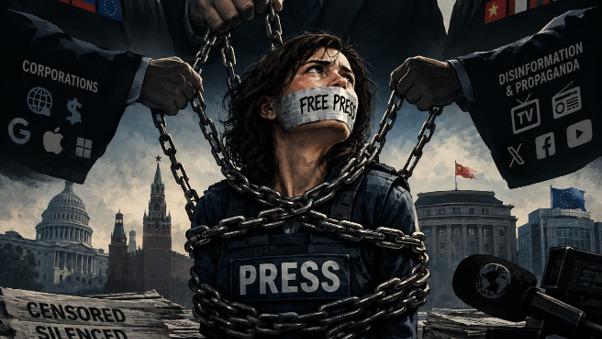
When a US
federal judge ordered the immediate restoration of White House press
credentials for three major news networks previously barred by the executive
branch, it signaled a vital victory for fundamental constitutional protections.
The legal pushback—backed by a remarkably unified coalition of competing
outlets including Fox News, CBS, ABC, NBC, and the Associated Press—reaffirmed
a foundational principle of open governance: no government has the authority to
dictate who covers it or to exclude reporters over critical coverage.
Yet, while
independent judicial intervention swiftly checked administrative overreach in
Washington, this event highlights a much broader and more dangerous trend
across the globe. Around the world, the environment for uninhibited reporting
is diminishing at an alarming rate. When authorities find coverage
disagreeable, the response is increasingly not dialogue, but suppression and
coercion.
Extreme
Persecution: The Tragedy in Gaza
The most
severe illustration of this crisis is currently unfolding in Gaza. According to
the Committee to Protect Journalists (CPJ) and International Federation of
Journalists (IFJ), the ongoing conflict has resulted in the deadliest period
for media workers since record-keeping began. Well over 150 journalists and
media professionals have been killed in Gaza—with some watchdog estimates
exceeding 200 fatalities—alongside dozens of arrests, detentions, and physical
injuries. Reporters on the ground face constant bombardment, destruction of
media offices, and severe personal peril simply for documenting conflict
conditions and civilian impact.
Systematic
Pressure and Legal Weaponisation in Pakistan
While
physical destruction marks conflict zones, subtle and institutional forms of
coercion are equally devastating in peacetime environments. According Freedom
Express, in Pakistan local press freedom groups such as Freedom Network have
documented over 150 journalist killings since the year 2000, with an appalling
impunity rate exceeding 90%. In recent years alone, dozens of journalists have
been detained, assaulted, or forced off the air.
Successive
administrations and powerful state actors have routinely applied pressure on
broadcasting houses to remove critical commentators from television screens,
inflicting severe economic and professional consequences on reporters who
refuse to align with official stances. Furthermore, as journalists shifted to
online platforms to maintain independence, authorities adapted by weaponizing
cybercrime legislation—most notably the Prevention of Electronic Crimes Act
(PECA). Under vague legal provisions regarding "defamation" or
"public order," digital commentators, YouTubers, and bloggers face
frequent arrests, raids, and formal charges aimed at suppressing dissent.
This
continuous cycle of violence, intimidation, and legal harassment explains why
Pakistan consistently ranks near the bottom of the Reporters Without Borders
(RSF) World Press Freedom Index.
A
Widespread Trend Beyond Borders
Gaza and
Pakistan are not isolated anomalies; they represent a global pattern spanning
South Asia, the Middle East, Latin America, and Eastern Europe. Across these
regions, press freedom is actively undermined not only by state authorities,
but also by powerful political factions, oligarchs, criminal syndicates, and
paramilitary groups. Reporters attempting to expose corruption, human rights
abuses, or institutional failures are routinely met with arbitrary detentions,
strategic lawsuits, economic strangulation, and deadly violence.
The
Urgency of Collective Action
The reversal
of the White House press ban proves that institutional safeguards and unified
media resistance can successfully halt state overreach. However, in regions
where judicial independence is compromised or physical safety cannot be
guaranteed, media professionals remain dangerously vulnerable.
Silencing
journalists does not erase reality; it merely denies the public access to truth
and weakens democratic accountability. The growing practice of muzzling press
outlets, prosecuting digital voices, and targeting reporters must be vigorously
opposed by international human rights monitoring bodies, civil society, and
legal institutions worldwide. Protecting press freedom is not a concession
granted by those in authority—it is an indispensable pillar of a free world,
and it requires global commitment to safeguard before independent journalism is
silenced entirely.